When the Voice on the Phone Sounds Exactly Like Family
The grandparent scam used to rely on a bad connection and panic. Now the voice is a match. What changed, and the one countermeasure that still works.
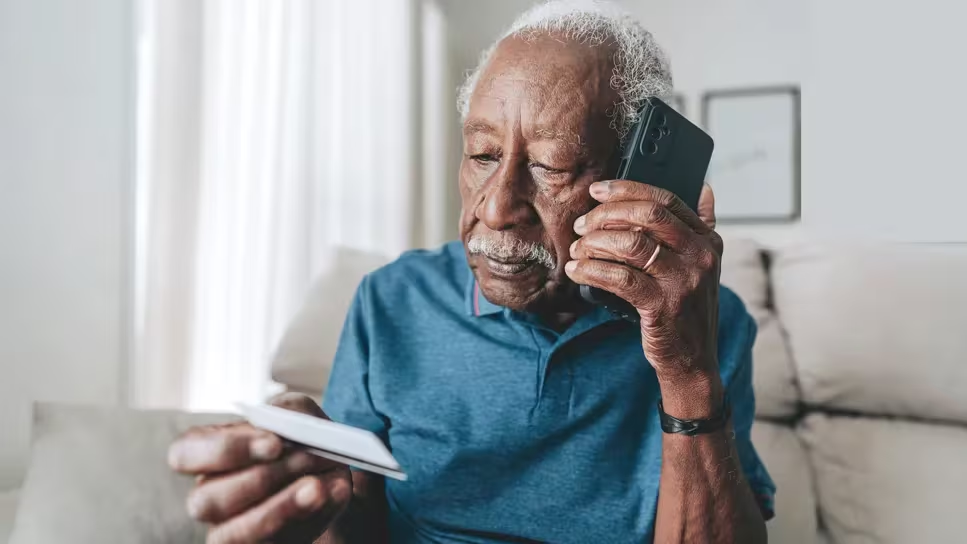
The old version of this scam had a weakness built into it, and everyone who studied it knew what the weakness was.
A caller would say Grandma, it's me and wait. If she said a name, they took it. The connection would be described as bad. There'd be a story about an accident, or an arrest in another state, and a request not to tell his parents because he was ashamed. It worked often enough to be a persistent problem, but it depended on panic doing the work that the voice couldn't — because the voice was a stranger's, and if she listened carefully, she'd hear it.
That weakness is gone.
The FBI's 2025 report devoted a section to artificial intelligence for the first time in its history. Adults 60 and over filed more than 3,100 complaints referencing AI, with reported losses exceeding $352 million. Distress scams using voice cloning specifically accounted for over $5 million in claimed losses in 2025 — a small number that is almost certainly a floor rather than a ceiling, because the Bureau notes that most victims never realized AI was involved in the first place. You can't report what you didn't detect.
What actually changed
Three things, and it's worth being precise about each, because the countermeasures follow from the mechanics.
The voice is now a match. Cloning a recognizable voice no longer requires a laboratory or a large sample. A short clip of someone speaking — a voicemail greeting, a few seconds of a video posted to Facebook, a comment on a public reel — is enough for consumer-grade tools. Which means the raw material is not stolen from anyone. It's the ordinary residue of a family that posts things.
The grammar tell is gone. The badly-written email was, for two decades, the most reliable amateur detection method available. It has stopped being useful. Text now arrives in fluent, natural, correctly-punctuated English, in whatever register the situation calls for.
Video is following. Deepfaked video calls exist and are being used, most visibly in fake celebrity investment endorsements and in romance fraud, where a short video call was until recently a reasonable proof-of-life test. It's now a weaker one.
The thing to internalize: every detection method that relies on your parent's senses has been degraded, and it will keep degrading. Advice built on listen carefully or look for the tells is advice with a short shelf life. What still works is procedural — things that don't require judging whether something sounds real.
Why panic is the actual weapon
The technology gets the headlines, but the voice isn't what makes this work. The emotional structure is.
A distress call is engineered to produce three effects in the first fifteen seconds. It's worth naming them, because a person who can recognize the pattern in the moment has a real chance.
Fear, aimed at a specific person she loves. Not a vague threat. Her grandson, by name, hurt or in a cell right now. Fear at that intensity measurably degrades the ability to evaluate evidence — this is true of everyone, at every age, and it's the reason the scam works on people who would spot a phishing email instantly.
Urgency with a deadline. Bail must be posted before the hearing. The hospital needs a payment before they'll proceed. The lawyer is stepping into court in twenty minutes. The deadline exists solely to prevent the fifteen minutes of reflection that would end it.
Shame-based secrecy. Please don't tell Mom and Dad, I'll tell them myself, I just can't have them know yet. This is the load-bearing element, and it's beautifully cruel: it recruits her love and her discretion to isolate her. A grandmother who agrees to keep a secret to protect her grandson's dignity has just, unknowingly, disabled the only verification step that would have saved her.
That last one is the reason to teach this pattern as a rule about secrecy rather than a rule about voices. The voice will keep getting better. The demand for silence is structural — the scam cannot survive a phone call to anyone else, so the demand can't be dropped.
The one countermeasure that still works
Hang up and call the person back on the number you already have.
That's it. It requires no technical knowledge, no ability to detect a synthetic voice, and no judgment about whether the story is plausible. If the grandson is genuinely in trouble, he answers or someone does, and thirty seconds of delay costs nothing. If he's asleep in his apartment, the scam ends without a dollar leaving the house.
Anticipate the objection, because the scammer has: they said his phone was taken, or he's in booking, you can't reach him. Fine — then call his mother. Call his roommate. Call anyone in the family. The rule isn't reach the person, it's verify through a channel they didn't hand you. Any resistance to that step is itself the answer.
On safe words. Family code words get recommended constantly, and they're not useless — but they're weaker than they look, and it's worth knowing why before relying on one. People forget them under acute stress, which is the only condition in which they'd be used. They only cover the family-impersonation category and do nothing for tech support or bank imposters. And a scammer met with "what's the word?" simply pivots to I'm too shaken to remember, Grandma, please. If you want one, set it — just don't let it replace the callback rule, which works in every category and can't be talked around.
What families can do this month
Reduce the raw material, without turning it into a fight. Publicly accessible video and audio of family members is the input. Locking down social media privacy settings, on both your parent's accounts and yours, is a reasonable and unglamorous step. So is a voicemail greeting that says the number rather than the name in a recorded voice. This is harm reduction, not prevention — the material is already out there for most families — but it lowers the odds of being an easy target.
Rehearse it once, out loud. Not a lecture. An actual walkthrough: if you ever get a call saying I'm hurt or arrested, here's what we do — you hang up, you call my cell, and if I don't answer you call Dave. Ten minutes, once. People remember procedures they've rehearsed far better than warnings they've been given, and this framing is collaborative rather than protective, which matters for whether it lands at all.
Say the secrecy rule as an absolute. No real emergency ever requires you to keep it from the family. If someone tells you not to call me, that is the moment to call me. This one sentence covers voice cloning, phantom hacker scams, romance fraud, and government impersonation simultaneously. If you get one sentence, make it this one.
Talk about money in advance. Agree that no money moves for any emergency without a second family member confirming — no exceptions, including for you. Set as a mutual rule rather than a restriction on your parent, it's much easier to accept, and it's the checkpoint that catches everything else.
If it already happened
Call the bank, the wire service, the gift card issuer, or the crypto exchange immediately — reversibility drops fast, and some of these have windows measured in hours. Report at ic3.gov and ReportFraud.ftc.gov, and file locally for the report number the bank will ask for. Expect a follow-up "recovery service" that promises to get the money back for a fee; it's the same operation making a second pass.
And then be careful with the first conversation, because it decides whether there's a second one.
The reason distress scams go unreported at such high rates isn't confusion. It's humiliation — a specific, sharp kind, because the person didn't just lose money, they were manipulated through their love for a grandchild, and part of them will keep replaying the call. The instinct to say why didn't you check is understandable and it is the single most damaging thing available to say.
Try instead: this is a professional operation, they used a recording of his actual voice, and I'm not sure I would have done anything differently at two in the morning. That's not a comforting fiction. Given what the technology can now do, it's a fairly accurate description of the situation.
Frequently asked questions
How much audio does someone need to clone a voice? Far less than most people assume — consumer tools can work from a short clip. Any publicly posted video with speech in it is potentially sufficient, which is why the practical advice concerns privacy settings rather than avoiding recording altogether.
Can you tell a cloned voice by listening? Sometimes, with a calm ear and a good connection — flat emotional range, odd pacing, strange breath sounds. But the whole point of a distress call is that your parent will not be calm, and the quality improves month over month. Any strategy that depends on detection by ear is borrowing against a shrinking margin.
Is a video call proof it's really them? Less than it used to be. Real-time video manipulation is in active use, particularly in romance and investment fraud. Video raises the bar for an attacker; it no longer clears it.
Should we set up a family code word? It's reasonable, with clear eyes about the limits: people forget them under stress, they cover only one scam category, and they can be talked around. Use one as a supplement to the callback rule, not as a replacement for it.
What's the very first thing to teach an older parent about this? Two sentences. Hang up and call back on a number you already have. And any instruction not to tell the family is the signal that it's a scam.
Ommpo Care gives families a live line a parent can call before acting on something urgent, plus monthly visibility into a parent's household charges and billing. Plans from $49/month.
General information, not legal or financial advice. Sources: FBI Internet Crime Complaint Center, 2025 Annual Report (released 2026), including its AI and distress-scam findings.